
We took over this Audi dealer’s Google Ads account in Q3 2020 — seemingly stable enough, around €15 per conversion, roughly fifty conversions a month. What wasn’t visible yet: their recent website rebuild had broken conversion tracking. The first weeks weren’t about bid strategy or budget. They were about figuring out what was actually being measured.
Industry: Automotive — official Audi dealer. Market: Netherlands. Engagement: Q3 2020 – Q3 2022 (24 months). Services: Google Ads · Conversion tracking · Campaign overhaul.
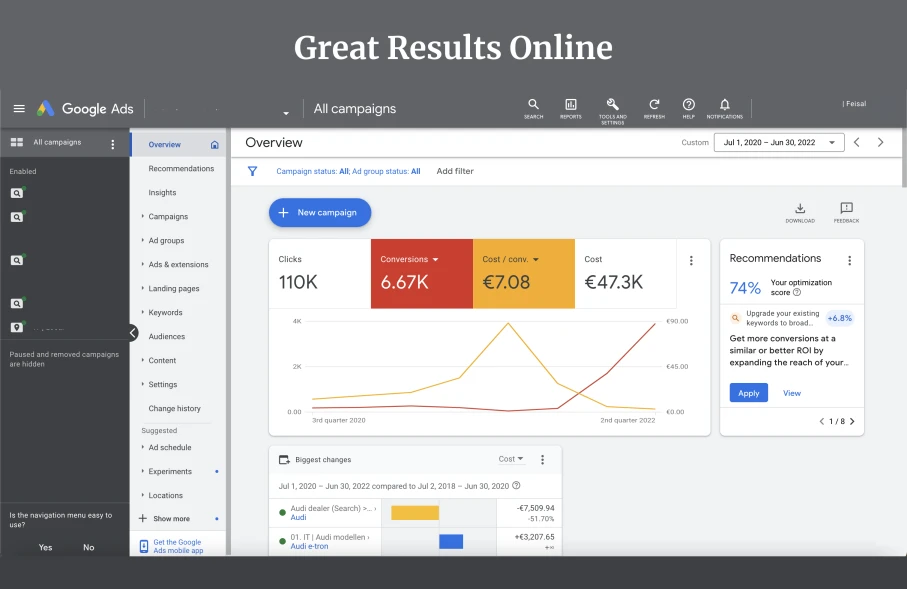
The curve says the most. Conversions (red) sit at zero through the end of 2020 because tracking was broken on arrival — then climb steadily once tracking was rebuilt and the campaign structure followed. By Q3 2022 the dealer was running at roughly a third of the inherited CPA, on much higher volume.
Fix the signal before anyone touches the bids
The website redesign that went live just before our takeover had quietly broken the handoff of conversion tracking between the site and Google Ads. Form submissions, phone clicks and lead-form events fired inconsistently or not at all. The €15 CPA the inherited reports showed was a half-truth — based on whichever events happened to still fire correctly.
The first weeks weren’t glamorous. Audit every conversion action, map each one to the right trigger after the redesign, rebuild what was broken, strip out what was counted twice.
Audit every conversion action, tie each one to the correct post-redesign trigger, rebuild what broke, remove what double-counted. Only after that does a bid decision mean anything.
With honest tracking, the campaign structure followed. Search campaigns were reorganized around the dealer’s actual lead-generating themes — model-specific demand, parts and service, electric models (Audi e-tron) as a separate intent cluster. Wasted spend on broad-matched terms was systematically trimmed.
Visible in the Biggest changes panel on the screenshot: an underperforming Search cluster cut by €7,509.94 (-51.7%), while spend was reallocated to the Audi e-tron cluster (+€3,207.65). One pull, one push — every shift defensible from the data.
After that the work shifted to maintenance: weekly search-term review, monthly performance check, seasonal alignment around Dutch car-buying cycles. Nothing dramatic — just no decisions on top of broken data, no chasing vanity metrics, no settling for “stable” when stable meant standing still.
By the end of the engagement the dealer was running at roughly a third of the inherited CPA, on much higher conversion volume. The before-and-after isn’t a one-week test result; it’s twenty-four months of small honest decisions stacking on each other.
Was able to work with Feisal for several years in the automotive industry. The goal of our cooperation was to generate as much revenue as possible with online activities for customers in this branch. Feisal has a good outlook and pragmatic approach.
24 months, 6,670 conversions, a third of the inherited CPA
The screenshot shows the averages: 110K clicks, 6,670 conversions, €47,300 spend across the whole engagement. The trajectory shows where the work was: tracking restored, then a slow steady climb in conversion volume on a falling cost per conversion.
Cost per conversion, before and after.
Most accounts hide their tracking problems under stable-looking numbers. The first thing we do in any audit is find them.
Boring, predictable, attributable. That’s what good PPC looks like.
Every engagement starts with a 30-minute audit — free, no slides, just a screen-share through your account.
Book the audit →