
We took over this Hyundai dealer’s Google Ads account in Q3 2020. The headline number was alarming: roughly €400 per lead. The account wasn’t broken — it just had no structure. Different intent levels were lumped into the same bid buckets, with barely any audience layers and no systematic discipline on negative keywords. Two years of granular rebuilding later, that same account produced leads for a fraction of that.
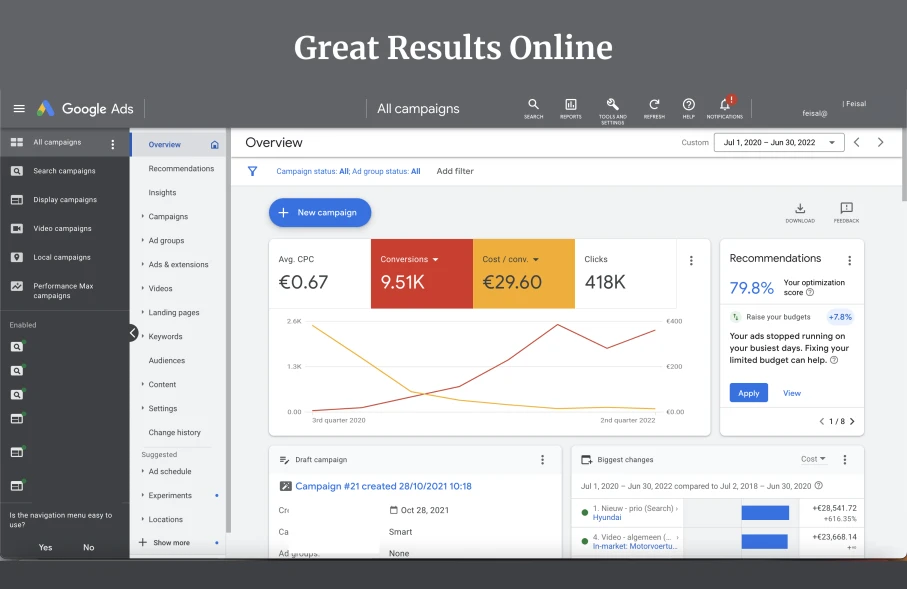
The Biggest changes panel tells the structural story directly: a new priority-tagged Search campaign drove +€28,541 (+616%) in budget that had previously gone unused, and an in-market video layer added +€23,668 of fresh demand capture. The €29.60 blended CPA across the full engagement reflects an account climbing up from a €400-per-lead starting point — not a steady-state benchmark.
What we did — first granular structure; the bidding follows
The inherited account was structurally lazy: broad campaigns covering everything from generic “Hyundai” searches to specific model intent to service-related queries, all sharing budget and bid logic. The first months went to breaking those campaigns into intent-mapped clusters — new-vehicle demand separated from financing/leasing intent, separated from parts and service, separated from defensive coverage against competitors.
Visible in the Biggest changes panel: a new priority-tagged Search campaign for Hyundai picked up +€28,541 (+616%) of additional budget over a 2-year baseline — demand the earlier flat structure missed entirely.
Keywords tell you what someone is searching for. Audiences tell you who is searching. With the restructured account stable, we layered Google’s in-market and affinity audiences on top as observe-then-bid-modifier signals — testing which audience clusters consistently outperformed and shifting budget toward them.
The in-market motor-vehicle video campaign that showed up as the fourth-largest budget increase (+€23,668) came out of this work: a deliberate placement of in-market intent against video creative that the inherited keyword-only setup would never have reached.
Once the structure and audience layers were in place, the work shifted to maintenance — and that maintenance is where cost per lead really dropped. Weekly search-term reviews, ruthlessly excluding queries that brought irrelevant traffic. Quarterly audits of audience segments to cut underperformers and shift budget. Seasonal tuning around the Dutch automotive sales cycle.
None of that is exciting. It’s also the difference between an account drifting back toward €400 per lead and an account climbing toward €10. The blended €29.60 across 24 months reflects the middle of that journey, not the endpoint.
Was able to work with Feisal for several years in the automotive industry. The goal of our cooperation was to generate as much revenue as possible with online activities for customers in this branch. Feisal has a good outlook and pragmatic approach.
By the numbers — 24 months, 9,510 conversions, a 40x drop in cost per lead
The screenshot shows the blended figures: 418K clicks, 9,510 conversions, €29.60 cost per conversion averaged across the full engagement. The trajectory shows where it went: from a starting point of roughly €400 per lead to around €10 by the end of the second year — an order of magnitude lower, reached without exotic tactics.
Cost per lead, before and after.
An account doesn’t have to be broken to be expensive. It just has to be unstructured.
Boring, predictable, attributable. That’s what good PPC looks like.
Every engagement starts with a 30-minute audit — free, no slides, just a screen-share through your account.
Book the audit →