We took over this B2B packaging retailer’s Google Ads account in 2020. ROAS was sitting around 6 — decent on paper, but with obvious slack: an unstructured Shopping feed, broad-match Search campaigns running without granular intent mapping. Then COVID hit, and most of their competitors paused their advertising entirely. We made the opposite call.
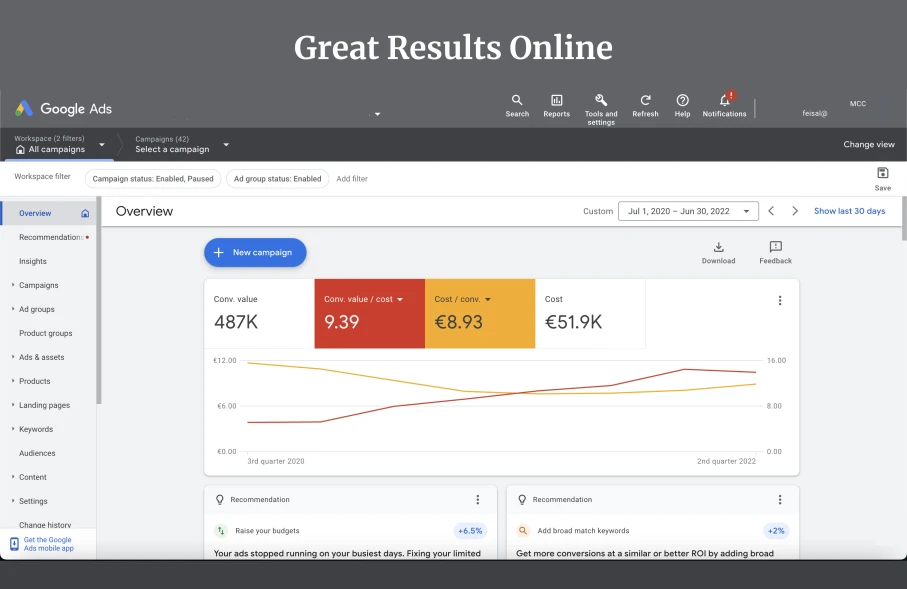
The two lines on the chart tell the work: cost-per-conversion (yellow) descending steadily from €12 down toward €8, while conversion value (red) climbs from near-zero through the COVID window. ROAS averaged 9.39x across the engagement and exited around 12x. €51.9K of ad spend pulled €487K of revenue.
Structure first, then a contrarian call when it mattered
01 · Tighten the feed — Channable-managed Shopping feed, product-by-product.
The inherited Shopping feed was the obvious lever. We restructured it through Channable — title patterns, brand and category attributes, custom labels — to give Google’s Shopping algorithm something it could actually rank on.
For a B2B catalogue with thousands of SKUs and tight margins, feed quality moves the ROAS needle more than bid adjustments ever will.
02 · Granular search — intent-mapped clusters, weekly experimentation.
On the Search side, broad-match catch-all campaigns got broken down into intent-mapped clusters — generic packaging searches separated from brand-specific intent, product-category clusters distinct from purchase-stage queries. A weekly experiment cadence: one variable changed at a time, kept what worked, killed what didn’t.
Average CPC settled at €0.67 over the 24-month engagement — possible only because the keyword structure was tight enough to keep Quality Scores high and bid auctions efficient.
03 · Stay in market — when competitors paused for COVID, we stayed.
When COVID hit in early 2020, the default move across the sector was to pause non-essential ad spend. The reasoning was understandable — revenue was uncertain, conserve cash. The packaging client made the opposite call: stay in market, capture the share their competitors were vacating.
The auction-pool data backed it up. With most competitors paused, CPCs dropped and impression share climbed without any bid changes. That window — measurable in the chart’s red line climbing while the yellow line falls — is where the ROAS doubled.
The decision that mattered most wasn't a setting change.
By the numbers
The screenshot shows the blended figures across the engagement: €487K conversion value, €51.9K total spend, 9.39x average ROAS, €8.93 average cost per conversion. The trajectory shows the journey: a ROAS that started near 6, exited above 12, and held the cost-per-sale roughly flat as volume scaled.
ROAS, before and after: the inflection sits in the COVID window, where competitors paused and we stayed in market.
Most agencies congratulate themselves for surviving COVID. The interesting ones used it.
Boring, predictable, attributable. That’s what good PPC looks like.
Every engagement starts with a 30-minute audit — free, no slides, just a screen-share through your account.
Book the audit →