We took over the Google Ads account of a Dutch architectural firm whose specialism is unmistakably narrow: iconic Dutch country-house and farmhouse architecture, designed and built for clients who arrive at the brief with a very specific brand of taste. The campaign that was meant to bring those clients in was hitting a peak cost of €140 per lead, with the conversion line essentially flat at one lead per week. Six months later it was running at €39.58 blended cost-per-conv across the engagement, with weeks where nine leads landed — a portfolio of high-intent farmhouse-architecture briefs the firm could actually choose from.
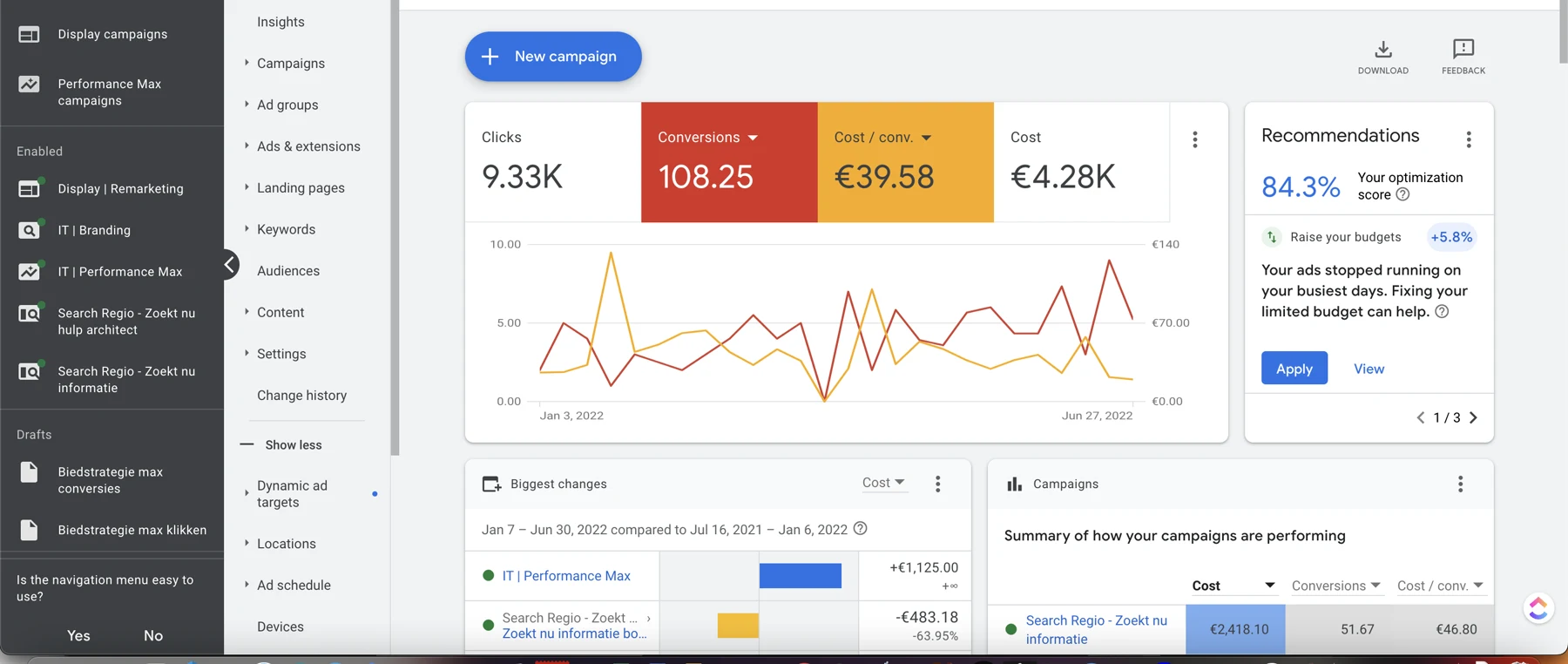
Read the chart left to right. The yellow cost-per-conv line starts above €100 and descends in steps through the engagement; the red conversion-volume line climbs from a flat baseline. Biggest changes panel: +€1,125 added to Performance Max once the catalogue of completed projects could feed it, and €483 pulled out of a regional Search cluster that wasn't converting at the same efficiency. Small absolute reallocations — on a small absolute budget — for a high-margin niche where one closed project pays back the entire engagement many times over.
What we did: first fix the conversion signal, then bid where the niche actually lives
The first work was unglamorous. The campaign had three legitimate ways a lead could arrive — a presentation-PDF download, a phone call via call-tracking, and a contact-form submission — and each was being measured in a different system, with the imports into Google Ads incomplete and overlapping. We rebuilt the conversion-tracking layer so that all three lead-types fed Google Ads as discrete primary conversion actions, each with the right value attached.
For a low-volume high-margin niche, the cost of optimising against a partially-broken signal is not a slow drift — it is months of paying €140 for clicks that look like the wrong leads because the real leads aren't being counted.
People commissioning a country-house architect do not type “architect” into Google. They type for help finding one in their region, with their style of brief in mind. We rebuilt the Search campaigns around regional intent-clusters separated from generic information queries — “looking for help with [region] country-house design” treated entirely differently from “[region] farmhouse renovation information”.
The clusters with commercial intent got budget; the information-stage clusters got starved.
With the tracking rebuild done and the regional Search clusters validating which clicks actually became leads, we layered in a PMax campaign — fed with the firm’s portfolio of completed country-house projects as visual assets. Visible in the Biggest changes panel of the screenshot: +€1,125 added to PMax over the engagement; it became the largest single budget mover.
By the end of the six months, weeks where nine leads came in were normal, and the blended cost-per-conv across the engagement was €39.58 — down from the €140 peak by more than 70%.
Performance Max only works when the conversion signal underneath it is honest.
By the numbers
The blended figures across the engagement: 9.33K clicks, 108 conversions, €4,280 total spend, €39.58 average cost per conversion. The trajectory shows where the work went: a cost-per-conv that fell from a peak of €140 to a trough of about €10 by Q2 2022, with weekly lead-volume climbing from 1 to a sustained 9-per-week.
Cost per conversion, peak to trough. From early in the engagement to the stabilised state.
For a high-margin niche, the win isn’t volume — it’s a portfolio of briefs the firm can actually choose from.
Boring, predictable, attributable. That’s what good PPC looks like.
Every engagement starts with a 30-minute audit — free, no slides, just a screen-share through your account.
Book the audit →