
This one sits outside our usual PPC lane. We built a multilingual WordPress webshop for a Dutch-Russian skincare brand — English on one side, Russian on the other, the same product catalogue, navigation, blog and customer reviews mirrored cleanly across both. WPML, the standard plugin for running multilingual WordPress at scale, picked up the build and featured it as a reference implementation. We are showing it here because the feature itself is the credibility signal — it is third-party recognition of the technical work, from the team that wrote the plugin.
The three pieces of the build that made it reference-grade
01 · Full-stack translation — every layer of the WooCommerce data model translated, not just the front-end copy.
Most “multilingual” WordPress sites translate the visible body text and stop. The categories stay in one language, the attribute slugs stay in one language, the URL structure stays in one language. We translated the full WooCommerce object graph through WPML — products, variations, attributes, taxonomies, blog categories, customer-review fields, checkout strings — so the Russian shopper landed on a site that did not feel like a translation pasted onto an English skeleton.
The reason WPML picked it up was specifically this layer. The plugin documentation uses Nazelie as an example of how an end-to-end product-data translation should look in practice.
02 · URL + SEO mirroring.
Russian search behaviour and English search behaviour do not overlap. We gave each language its own URL tree, its own sitemap, its own hreflang declarations, its own meta and its own product schema. Google indexed the two sides as parallel destinations rather than duplicate content, and the Russian side could be optimised against Russian search intent without the English side fighting it.
Two complete sitemaps, two hreflang trees, one canonical install.
03 · Design consistency across locales.
A heritage skincare brand has a specific voice, and that voice has to survive translation. We worked with the brand to make sure the Russian copy was not a literal translation of the English — it was rewritten in the register the Russian-language customer expected, with the same product story underneath. Layout, typography, imagery and navigation logic stayed identical across the two locales so the brand read as one company, not two.
Same brand grammar, two language registers.
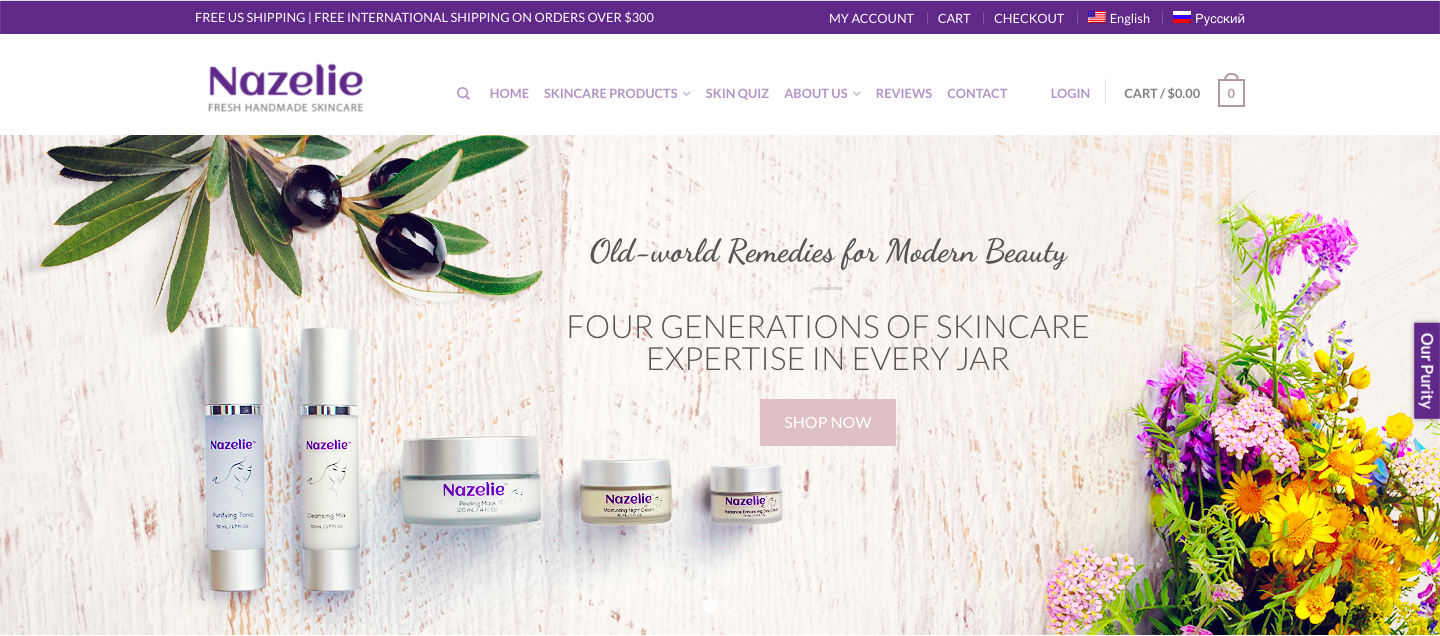
The work that matters on a build like this is not visible in the screenshot — it is in the language-switching infrastructure underneath. Product variants, attribute slugs, category trees, blog taxonomy, customer-review schema and the checkout flow all have to mirror cleanly between English and Russian, with the URL structure, hreflang signals and currency display reading correctly to both Google and the customer. We did that work, and the WPML team noticed.
By the numbers
A reference-grade multilingual build is one the plugin author is willing to point other builders at. WPML pointed at this one.
Most of what we do today is paid acquisition — Google Ads, Microsoft Ads, conversion-tracking, CRO. But the bench underneath that includes builds like this. If you have a webshop that needs to ship into a second language without losing its grip on search, we can talk.
Boring, predictable, attributable. That’s what good PPC looks like.
Every engagement starts with a 30-minute audit — free, no slides, just a screen-share through your account.
Book the audit →